

A catalytic converter, or catalytic converter, is a component located under vehicles, between the engine and the exhaust pipe. Its function is to reduce exhaust gases that are harmful to the environment. What is special about a catalytic converter? It can contain three precious metals: platinum, palladium, and rhodium.
Let’s first look at the composition and functioning of a catalytic converter, then how this part can be recycled.
Composition and functioning of a catalytic converter
The catalytic converter consists of a stainless steel casing containing a ceramic block. The ceramic contains microcells—a bit like a honeycomb—which are coated with precious metals. These act as a catalyst, accelerating chemical reactions.
Carbon monoxide, nitrogen oxides, and hydrocarbons enter the catalytic converter. When they exit the converter, the gases are transformed into carbon dioxide, nitrogen, and water vapor, which are less harmful.
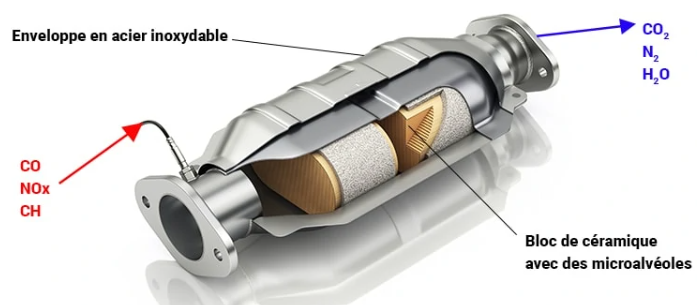
The amount of precious metals in catalytic converters depends on the engine, the type of fuel, and the year of production. It varies between 2 and 10 grams per catalytic converter.

Commitment to sustainable development encourages, and even requires, the use of increasingly efficient catalytic converters. And this efficiency is correlated with the amount of precious metals used.
When a vehicle is taken out of service, it is important to recycle these catalytic converters, both from an environmental and economic perspective. A new catalytic converter can cost up to €3,000.
At the end of its life, the catalytic converter can be resold for a few hundred euros. There are businesses that specialize in buying catalytic converters.
But how can you determine the fair price of a catalytic converter ?
Portable XRF spectrometry for determining Pt, Pd, and Rh content
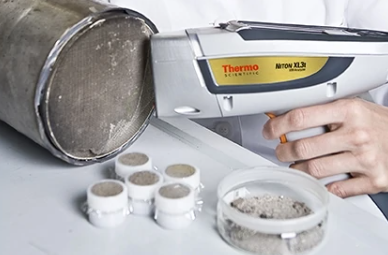
The buyback price of an end-of-life catalytic converter depends on the brand, the content of precious metals, and the market price of these metals. Portable XRF spectrometry is used to quickly and accurately determine the platinum, palladium, and rhodium content.
Before analyzing with a portable XRF spectrometer, the sample must be prepared. This involves:
- Removing the ceramic block from the stainless steel casing;
- Grinding the ceramic into a fine powder.
A portable XRF spectrometer can then be used to perform a quantitative analysis of platinum, palladium, and rhodium.
XRF analyzers are valued for identifying catalytic converters because they are accurate, compact, and fast. For more information, contact a portable spectrometry expert.