
PMI (Positive Material Identification) tests are widely used in many industries to ensure that materials comply with their specific specifications. In many industries and factories, such as Armstrong International, these tests are performed as part of quality control using XRF spectrometry.

Founded in 1900 in the United States, Armstrong International is a privately held company, managed by the fifth generation of the founding family. The company offers solutions for optimizing industrial thermal installations: steam and condensate, hot water, residual heat recovery, and high-temperature heat pumps, as well as energy audits (including Pinch), equipment manufacturing, and project implementation to ensure better installation performance for customers in a variety of industrial sectors. We spoke with Christophe Archambeau, Quality Manager at Armstrong’s Europe/Middle East/Africa (EMEA) subsidiary, based in Herstal, Belgium, since 1969.
What is the context for quality control in your company? And what are the main challenges?
At Armstrong International, our quality control department conducts regular tests throughout the production chain.
From the outset, raw or pre-machined products arriving from our sister companies or external suppliers are checked upon receipt at the factory to pass a validation test before use. We then monitor production through regular self-checks to detect any anomalies, such as a mix-up in stock or accidental exchange of parts (this is very rare but can happen). Finally, as part of the inspection of the finished product, usually with our customers. The tests carried out by XRF spectrometry are non-destructive, so we can show the chemical composition of the product and verify its compliance. All analytical data is stored, everything is traced, and each analysis is linked to the production order and the product concerned.
We may also have specific inspection plans for certain orders. Some customers, such as engineering firms, require ITPs (Inspection and Test Plans), which are inspection plans listing the production stages and the various checks that must be carried out at each of these stages. PMI checks are regularly required for all stainless steel products.
The main concern for customers, and for us as a manufacturer, is material errors. It is clearly impossible to tell the difference between two stainless steel bars with the naked eye, so we have to check the quality of the product by performing an PMI test to quickly identify the different types of stainless steel (304, 316, or 303, for example). If a material does not meet the standards or specific specifications, it will be unsuitable for its intended use because it does not have the required qualities. This could be poor corrosion resistance, for example. On our side of the production process, we may end up with inappropriate stainless steel machining that goes through chemical pickling and passivation treatment. All of this has a cost and a direct impact on production.
Having the right steel for the right use is extremely important, which is why quality control is carried out throughout the production chain.
Since 2020, you have been equipped with the Niton XL2 Plus analyzer. Tell us about your experience with the device.
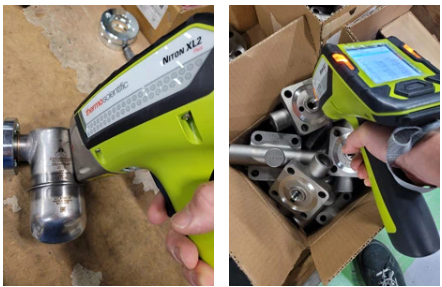
Our old analyzer was getting old and we were facing potential reliability issues. In addition, maintenance costs were becoming increasingly high. After hesitating between the LIBS and XRF methods, we opted for XRF because it is a recognized technology. XRF testing is required in most of our customers’ specifications.
🔗 See also our article > XRF or LIBS: which analyzer to choose?
We compared the different solutions and chose the Niton XL2 Plus, not only to streamline our brands across the Group, but also for its robustness. Being able to replace the batteries while the device is running is a real plus because it means you don’t have to shut down the device and then restart it. This is very efficient when you have to take large series of measurements. The portability of the device was a given; it is important to be able to move around the workshop or the customer’s premises to carry out tests.
The device is quite simple and intuitive to use thanks to its icon-based system. Fondis Electronic provided us with training on configuration options, data transfer and retrieval, and how to use the welcome stand for small parts.
As a distributor of portable physical and chemical solutions, Fondis Electronic offers a wide range of XRF spectrometers used in numerous industrial material testing applications. Our goal? To better understand the challenges faced by our industrial customers in order to assist them in their choices and offer them tailored solutions.