
An X-ray fluorescence spectrometer can quickly, accurately, and non-destructively determine the chemical composition of a sample.
To understand how X-ray fluorescence works, we need to define a few concepts :
The atom
Everything around us is made up of atoms.
Even our bodies are made up of atoms. These tiny particles are composed of protons (positively charged), neutrons (uncharged), and electrons (negatively charged).
Protons and neutrons make up the nucleus of the atom.
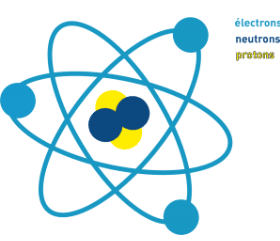
The number of electrons or protons determines the properties of the atom.
Niels Bohr (20th-century Danish physicist) proposed a model of the atom:
Electrons revolve around the nucleus, moving in certain permitted circular orbits that correspond to a specific energy level. This is what gives the atom its stability.
Radiation is emitted when an electron “jumps” from one orbit to another orbit with lower energy. The radiation is emitted in the form of a photon. Its energy corresponds to the difference in energy between the two orbits.
X-rays
Radiation is an emission of energy. We are surrounded by many types of radiation, both visible and invisible (light, microwaves, radio waves, ultraviolet rays, etc.).
X-rays are called “ionizing” because they emit energy rays capable of transforming the atoms they pass through.
X-ray fluorescence
Our X-ray fluorescence spectrometers have a tube that emits X-rays toward the sample.
This incident energy ejects electrons from the inner layer. (We are only interested in the K, L, and M layers.)
The inner layers reorganize themselves by recovering electrons from the upper layers to return to a stable state. The difference in energy levels between the different layers causes secondary emission: this is X-ray fluorescence.
The photons interact with the silicon crystal of the detector to create an electrical signal that is proportional to the energy of the photon.
The signal is amplified and shaped by the encoder to generate a spectrum.
The spectrum is processed by software to calculate the composition of the sample.
The K, L, and M layers of the atom
Electrons orbit the nucleus of the atom and are distributed in electron layers called K, L, M, etc.
The K layer can contain 2 electrons, the L layer 8 electrons, and the M layer 18 electrons.
Portable XRF spectrometers
For light elements such as magnesium, aluminum, silicon, phosphorus, and sulfur, a spectrometer equipped with a GOLDD SDD (Silicon Drift Detector) should be chosen.
Our portable XRF spectrometers, such as the FEnX-T, can be used for a wide range of applications: metal recycling, quality control in manufacturing and production, PMI (material identification) testing, soil pollution, inspection of pipes, welds, tanks, refineries, nuclear power plants, etc. The spectrometers are versatile.
To learn more about how X-ray fluorescence works, please contact our team of experts, unique in France.